PLC- and VFD-based automation systems integrating EtherCAT and Modbus TCP/RTU for real-time industrial coordination.
Category
Industrial Automation
Year
Jan 2021 - Dec 2024
Context
Barman Afzar Fidar (Jan 2021 - Dec 2024)
My Role
Developed PLC automation logic and safety-oriented sequence control.
Integrated EtherCAT master configuration and slave commissioning.
Tuned VFD parameters for load-adaptive motion stability.
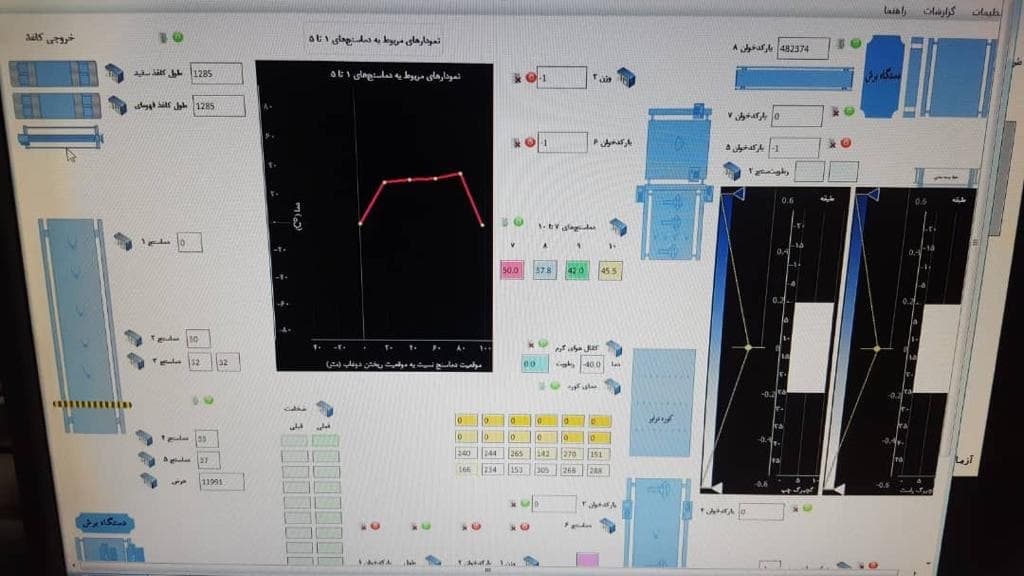
Configured Modbus TCP/RTU supervisory paths and HMI integration.
Technical Stack
Siemens S7-1200
TIA Portal
WinCC
VFDs
EtherCAT
Modbus
PLC
VFD
System Architecture
PLC manages automation sequence and safety-oriented control logic.
VFDs provide closed-loop motor control with load-adaptive tuning.
EtherCAT carries deterministic real-time coordination between PLC and drives.
Modbus TCP/RTU carries supervisory and auxiliary data to HMI and monitoring systems.
Engineering Challenges
Diagnosing communication faults across mixed-vendor EtherCAT and Modbus networks.
VFD tuning under variable mechanical loads without system instability.
Maintaining real-time determinism in electrically noisy factory environments.
Results / Outcomes
Improved motion stability under variable load across multiple drive configurations.
Reliable multi-vendor integration between Siemens PLC and third-party VFDs.
Consistent operation in electrically noisy industrial environments.
Engineering Notes
Two Communication Problems, Two Protocols
Industrial automation systems have two fundamentally different communication requirements: the real-time loop that coordinates motion and control, and the supervisory path that carries status, alarms, and configuration data to monitoring systems. Using one protocol for both problems is a common mistake that produces a system that either sacrifices real-time determinism or burdens the real-time network with traffic it was not designed for.
This system used EtherCAT for the deterministic real-time path and Modbus TCP/RTU for supervisory communication — matching protocol characteristics to the requirements of each data flow.
Industrial Control Network
S7-1200 PLC
EtherCAT Master
VFD Slaves
Modbus TCP/RTU
WinCC HMI
EtherCAT: Why Determinism Matters for Motion
EtherCAT is a real-time Ethernet fieldbus that achieves deterministic cycle times by processing data on the fly as the telegram passes through each slave device. Unlike standard Ethernet, where packets are received, buffered, and processed sequentially, EtherCAT slaves read and write data into the passing telegram without storing it — the result is sub-millisecond cycle times with jitter measured in microseconds.
For coordinated motion control across multiple VFDs, this matters. A PLC issuing velocity setpoints to three drives over a protocol with variable latency will see the drives execute at different times, producing motion errors that accumulate over cycles. EtherCAT's synchronization — using distributed clocks to timestamp events across the network — ensures all drives act on the same setpoint at the same moment.
The Siemens S7-1200 PLC acted as EtherCAT master, with VFD drives as slaves. TIA Portal's drive commissioning tools handle EtherCAT slave configuration (EEPROM, PDO mapping, sync manager setup) but the real integration work is in the PLC program: mapping process data objects to controller variables, handling drive state machine transitions (initialization, pre-operational, operational), and building fault response logic that handles drive faults without disrupting the rest of the sequence.
Modbus: Supervisory Communication
The WinCC HMI and remote monitoring connections used Modbus TCP over Ethernet, with Modbus RTU on RS-485 for some legacy instrument interfaces. Modbus is not real-time — polling latencies in the hundreds of milliseconds range are normal — but it is simple, widely supported across vendors, and entirely adequate for supervisory data that does not drive the control loop.
Keeping supervisory traffic on a separate Modbus path rather than on the EtherCAT network protects real-time behavior. A WinCC polling request that competes with motion control telegrams on the same network can introduce jitter; isolating the networks eliminates the interference.
VFD Tuning Under Variable Load
Variable Frequency Drives control motor speed by modulating the frequency and voltage of the AC supply. The internal control loop — typically a vector control or DTC algorithm — requires tuning parameters (proportional, integral, speed filter, flux reference) that interact with the mechanical system the motor is driving.
Auto-tuning routines built into the drive can identify motor electrical parameters (stator resistance, inductance, flux saturation) but they do not characterize the mechanical system. Manual tuning of the speed controller gains — starting with conservative proportional gain and increasing until the onset of instability is visible, then backing off — was necessary for each drive configuration to achieve stable motion under the actual operating load range.
EtherCATdeterministic motion sync
Modbussupervisory isolation
Multi-vendorPLC + third-party VFDs
Load-tunedVFD stability
Integration Across Vendors
The PLC was Siemens; the VFDs were from a third-party manufacturer with EtherCAT support. Cross-vendor EtherCAT integration is reliable when the ESI (EtherCAT Slave Information) file for the drive is correct and the PDO mapping matches what the PLC program expects — but when there are discrepancies, the failure modes are not always obvious. A drive that initializes but does not reach operational state, or one that enters operational state but does not respond to setpoints, requires methodical examination of the EtherCAT state machine and the mapped process data.
Working across vendor documentation — Siemens TIA Portal on one side, third-party drive manuals on the other — and finding the mapping between their respective naming conventions for the same underlying EtherCAT concepts is a practical integration skill that is not covered in either vendor's tutorial.
Engineering Takeaway
Industrial communication protocol selection is an architectural decision that affects reliability as much as the PLC program or drive tuning. Choosing EtherCAT for real-time control and Modbus for supervisory data is not an arbitrary preference — it is matching the characteristics of each protocol to the requirements of the data it carries. Systems that mix these appropriately are more maintainable and more reliable than systems that use one protocol for everything because it was already in use.
Developed an industrial electromagnetic slag-detection platform for molten-steel casting optimization using FPGA-based signal analysis, custom six-layer PCBs, industrial PLC systems, and real-time electromagnetic sensing.
Developed a distributed industrial process-monitoring system for drywall manufacturing using STM32 embedded hardware, Modbus RTU/TCP communication, custom infrared temperature sensing, and centralized Python-based monitoring software.
Led the research and development of industrial IoT telemetry systems based on STM32 embedded hardware, GSM communication, industrial Modbus networking, and cloud-connected monitoring infrastructure, with more than 2000 deployed devices across industrial and medical applications.