Back to case studies

Computer Vision

Industrial Image and Video Dehazing Research for Autonomous Vision Systems

Conducted industrial AI research on image and video dehazing using transformer-based architectures, diffusion-assisted reconstruction, optical flow, and hybrid dual-domain neural networks during a Mitacs internship at MacDon Industries.
  • PyTorch
  • Transformers
  • Stable Diffusion
  • Video Diffusion
  • Optical Flow
  • Deep Learning
  • Computer Vision
Industrial Image and Video Dehazing Research for Autonomous Vision Systems project media

Summary

Engineering context

Conducted industrial AI research on image and video dehazing using transformer-based architectures, diffusion-assisted reconstruction, optical flow, and hybrid dual-domain neural networks during a Mitacs internship at MacDon Industries.

Category
Computer Vision
Year
Jan 2025 - Jan 2026
Status
Research Internship
Context
Mitacs @ MacDon Industries (Jan 2025 - Jan 2026)

My Role

Computer Vision and AI Research Engineer

Technical Stack

  • PyTorch
  • Transformers
  • Stable Diffusion
  • Video Diffusion
  • Optical Flow
  • Deep Learning
  • Computer Vision
  • AI Research
  • Image Restoration
  • Video Processing
  • Diffusion Models
  • Mitacs

System Architecture

  • Dual-domain transformer architecture processed spatial and frequency-domain image information
  • Video dehazing pipeline integrated temporal consistency mechanisms
  • Stable Diffusion and Video Stable Diffusion assisted patch reconstruction workflows
  • Optical-flow-guided moving frame windows improved temporal reconstruction consistency
  • AI perception systems targeted industrial autonomous-vision applications

Engineering Challenges

  • Maintaining temporal consistency in video dehazing
  • Reconstructing degraded image regions reliably
  • Integrating diffusion-based reconstruction into restoration pipelines
  • Handling moving particles and dynamic scene degradation
  • Improving dehazing quality for autonomous-vision applications

Hardware / Firmware / Software

Hardware

  • GPU-accelerated AI training systems
  • Industrial imaging datasets

Software

  • PyTorch
  • Transformer architectures
  • Stable Diffusion
  • Video Stable Diffusion
  • Optical flow pipelines
  • AI research frameworks

Sensors

  • Industrial imaging systems

Results / Outcomes

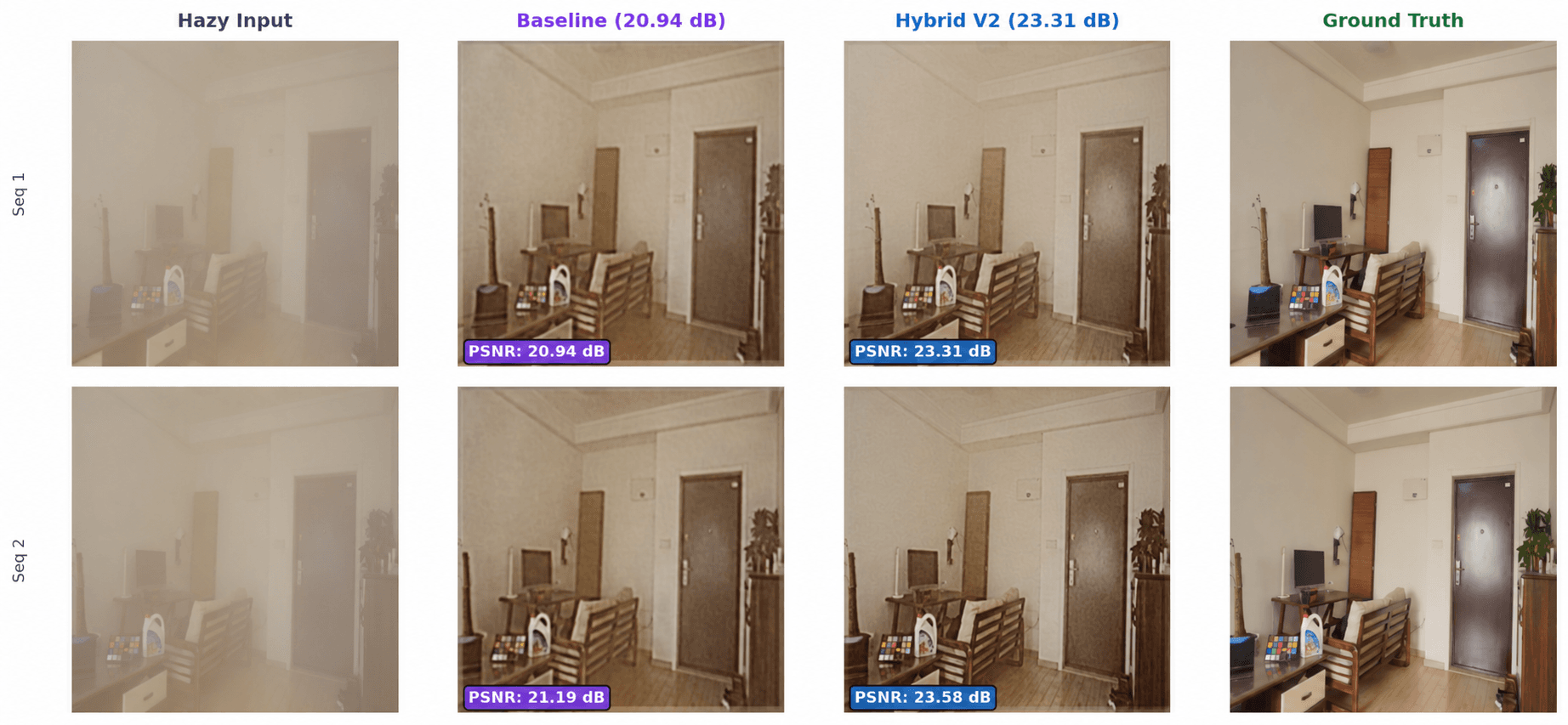
  • Developed hybrid dual-domain transformer dehazing architectures
  • Developed image and video dehazing pipelines
  • Integrated diffusion-assisted patch reconstruction systems
  • Implemented optical-flow-guided temporal reconstruction workflows
  • Conducted industrial AI research under Mitacs internship collaboration
  • Two research papers submitted for peer review

Engineering Notes

Dual-Domain Transformer Architecture

A hybrid dual-domain transformer architecture was developed to process:

  • spatial-domain image information
  • frequency-domain image information

The architecture targeted improved restoration of degraded industrial imagery and enhanced visual clarity for autonomous-vision systems.

Video Dehazing and Temporal Processing

Video dehazing pipelines were developed using:

  • optical flow
  • moving-frame temporal windows
  • temporal consistency mechanisms

The system attempted to preserve temporal stability while restoring degraded video sequences.

Diffusion-Assisted Reconstruction

Stable Diffusion and Video Stable Diffusion were integrated into reconstruction workflows for:

  • degraded-region reconstruction
  • patch restoration
  • image enhancement
  • video refinement

The diffusion-assisted approach was explored for improving reconstruction quality in heavily degraded scenes.

Industrial AI Research

The research targeted industrial autonomous-vision applications where airborne dust and haze reduce perception quality.

Experiments were conducted using industrial datasets including RVID-based evaluation workflows.

Research Outcomes

The project resulted in:

  • multiple experimental AI architectures
  • industrial image-restoration pipelines
  • video dehazing systems
  • temporal reconstruction workflows

Two research papers related to the work were submitted for peer review.